
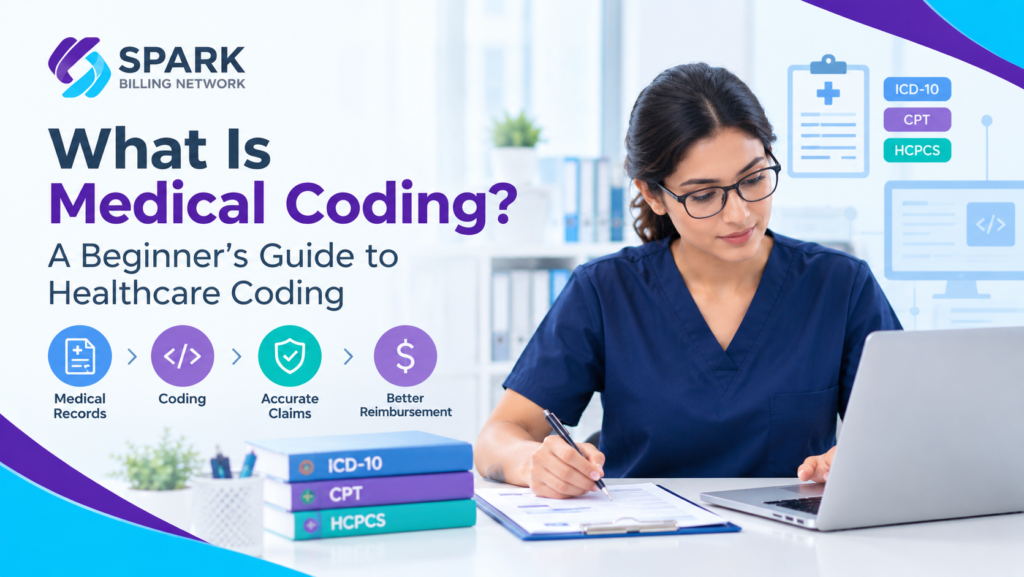
Medical coding is the process that turns what happens during a patient visit into standardized codes that healthcare systems can use. When a physician documents a diagnosis or a procedure, that information doesn’t go straight to an insurance company in plain language. It first has to be translated into codes, which is where medical coding comes in.
Healthcare providers rely on coding because it connects clinical documentation with billing and insurance claims. Without accurate codes, claims can’t be processed correctly. This matters for every healthcare organization, from small practices to hospitals, because coding accuracy affects how claims are understood and paid.
This guide explains what medical coding means, how the coding process works, the main types of codes, how coding differs from billing, and when a practice might consider professional coding support.
What Is Medical Coding?
Medical coding is the process of translating information from healthcare documentation, such as physician notes, test results, and treatment records, into standardized codes that describe diagnoses, procedures, treatments, and services.
The relationship generally looks like this:
Patient Visit → Clinical Documentation → Medical Coding → Claim/Billing → Insurance Processing
A patient is seen, the provider documents what was found and done, a coder reviews that documentation and assigns the appropriate codes, and those codes become part of the claim submitted to the insurance company.
Medical Coding Definition
In simple terms, the medical coding definition is this: medical coding is the practice of converting documented clinical information into standardized code sets used throughout healthcare administration, billing, and reporting. These codes give every diagnosis, procedure, and service a consistent, recognizable format that providers, payers, and healthcare systems can all interpret the same way.
What Does Medical Coding Mean in Practice?
It helps to see what medical coding means with a simple example. A physician documents that a patient was treated for a specific condition and received a particular service during the visit. A medical coder then reviews that documentation and assigns the codes that correspond to the diagnosis and the service, following applicable coding guidelines.
Medical coding doesn’t just mean entering numbers into a computer. It involves reading and understanding documentation, recognizing medical terminology, identifying the diagnoses and services that were actually provided, and selecting the codes that accurately represent them.
How Does Medical Coding Work?
1. Review the Patient’s Medical Record
The coder begins by reviewing the relevant documentation in the patient’s record. This typically includes physician notes, patient history, documented diagnoses, procedures performed, treatment information, and test results.
2. Identify Diagnoses and Services
From that documentation, the coder identifies which conditions were treated and which services or procedures were actually performed during the visit.
3. Select the Appropriate Codes
Using standardized code sets and applicable coding guidelines, the coder assigns the codes that correspond to the identified diagnoses and services.
4. Verify Documentation and Coding Accuracy
Before codes move forward, they’re checked against the documentation to confirm that each code selected is actually supported by what’s written in the record.
5. Submit Coded Information for Billing
Once verified, the coded information becomes part of the claim and moves into the billing process, where it’s used to generate and submit the insurance claim. (This is where coding connects directly to medical billing.)
What Are the Main Types of Medical Codes?
ICD-10-CM Codes
ICD-10-CM codes are generally used to report diagnoses and health conditions, describing the “why” behind a visit or service.
CPT Codes
CPT codes are used to report many medical procedures and professional services, describing the “what” that was done during the visit.
HCPCS Codes
HCPCS codes cover certain products, supplies, services, and procedures that fall outside the scope of CPT, such as some durable medical equipment and specific services.
Each code set serves a different purpose, and most claims rely on a combination of them to fully describe a patient encounter.
What Does a Medical Coder Do?
A medical coder is the person responsible for reviewing medical records and translating that documentation into the appropriate codes. Coders work closely with providers, billing teams, auditors, and other healthcare staff to make sure coded information is accurate and properly supported.
Typical responsibilities include:
- Reviewing medical records
- Identifying diagnoses
- Identifying procedures and services
- Assigning appropriate codes
- Checking that documentation supports the codes selected
- Following current coding guidelines
- Supporting accurate billing
- Flagging potential coding issues or documentation gaps
Attention to detail matters a great deal in this role, since even small coding errors can affect how a claim is processed.
Why Is Medical Coding Important in Healthcare?
Medical coding plays a role in several parts of a healthcare organization’s operations. It:
- Supports accurate medical billing
- Helps communicate clinical information in a standardized way
- Supports the insurance claims process
- Helps keep healthcare records organized and consistent
- Supports healthcare reporting and data analysis
- Helps identify discrepancies between documentation and coding
- Contributes to a more organized Revenue Cycle Management overall
Accurate coding doesn’t guarantee reimbursement. What it does is support accurate claims and appropriate reimbursement when the documentation is complete and payer requirements are met.
What Is Healthcare Coding, and How Is It Different?
“Healthcare coding” is a broader term that can include coding activities across many different settings and services, such as physician practices, hospitals, outpatient facilities, specialty practices, and telehealth. “Medical coding” is often used more narrowly to refer to the coding of diagnoses and procedures for a specific patient encounter. In practice, the two terms overlap significantly, and healthcare coding simply reflects the wider range of environments where coding takes place.
What Is Medical Records Coding?
Medical records coding refers to the process of coding based on the information contained in a patient’s medical record. Documentation is the foundation of this process: coders review the relevant record, and every code assigned must be supported by what’s documented there.
Incomplete or unclear documentation can create real coding challenges, since a coder can’t assign a code for something that isn’t clearly recorded. This is also where coding audits come in. Audits review coded claims against documentation to check for accuracy and consistency, helping catch mismatches before they become billing issues.
Common Medical Coding Challenges for Healthcare Practices
Incomplete Documentation
When documentation is missing details, coders may not have enough information to assign accurate codes.
Incorrect Code Selection
Choosing a code that doesn’t precisely match the documented diagnosis or service can lead to claim issues.
Outdated Coding Knowledge
Code sets and guidelines are updated regularly, and outdated knowledge can lead to errors.
Complex Medical Terminology
Clinical documentation often uses specialized terminology that requires strong medical knowledge to interpret correctly.
Specialty-Specific Coding Requirements
Different specialties have their own coding nuances, which can be difficult to keep up with across a varied practice.
Coding and Documentation Mismatches
When documentation and the codes assigned don’t align, it can raise flags during claims processing or audits.
High Coding Workload
As patient and claim volume grows, coding staff can become stretched thin, increasing the risk of errors or delays.
Medical Coding vs. Medical Billing: What’s the Difference?
Medical Coding | Medical Billing |
Converts clinical documentation into standardized codes | Manages the financial and claim process |
Focuses on diagnoses and services | Focuses on claims, payments, and balances |
Reviews medical records | Processes billing information |
Supports accurate claims | Follows claims through to reimbursement |
Coding and billing work closely together, but they are not the same function. Coding translates clinical information into standardized codes; billing uses those codes to generate, submit, and follow up on claims.
When Should a Practice Consider Medical Coding Services?
A practice might look into additional coding support when it’s dealing with:
- Growing patient volume
- Increasing documentation workload
- Limited internal coding staff
- Coding backlogs
- Frequent coding questions from providers
- A need for coding audits
- Multiple specialties to code for
- Telehealth services
- A need for ongoing coding education
Outsourcing isn’t the only answer, but it’s a reasonable option worth evaluating when internal coding resources are stretched.
What Are Healthcare Coding Services?
Professional healthcare coding services can include medical record review, diagnosis coding, procedure coding, E/M coding, specialty-specific coding, telehealth coding, coding audits, coding quality reviews, and provider coding education. The specific scope varies by provider, so it’s worth confirming exactly what’s included.
How Spark Billing Network Supports Medical Coding
At Medical Billing Network, we support practices with medical coding services that include coding and auditing, E/M coding, telehealth coding, external coding audits, independent coding reviews, provider education, and customized coding support based on specialty and volume. Whether a practice needs ongoing coding support or a one-time audit, we work to keep coding accurate, well-documented, and aligned with current guidelines.
Frequently Asked Questions About Medical Coding
What is medical coding?
Medical coding is the process of translating clinical documentation, such as diagnoses, procedures, and treatments, into standardized codes used for billing, insurance claims, and healthcare reporting.
What is the medical coding definition?
Medical coding is the practice of converting documented clinical information into standardized code sets used throughout healthcare administration, billing, and reporting processes.
What does medical coding mean?
Medical coding means reviewing a patient’s documented diagnosis and treatment, then assigning the codes that accurately represent them, based on established coding guidelines rather than simple data entry.
What does a medical coder do?
A medical coder reviews medical records, identifies diagnoses and services, assigns the appropriate codes, verifies that documentation supports those codes, and works with providers and billing teams to support accurate claims.
What is medical records coding?
Medical records coding is the process of assigning codes based on information documented in a patient’s medical record. Every code must be supported by that documentation, which is why clear, complete records matter.
What are healthcare coding services?
Healthcare coding services typically include medical record review, diagnosis and procedure coding, specialty-specific coding, telehealth coding, coding audits, and provider education, supporting accurate and compliant coding across a practice.