
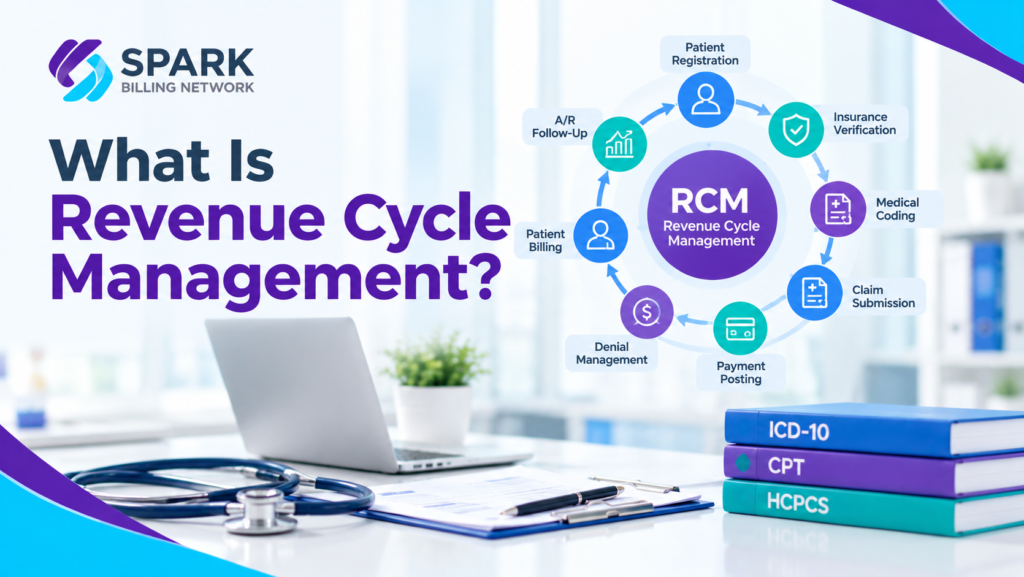
Revenue cycle management (RCM) is the process healthcare organizations use to manage the financial and administrative activities tied to patient care, from the first appointment or registration through billing, payment, and account resolution.
The revenue cycle typically moves through these stages: Patient Registration → Insurance Verification → Documentation → Coding → Claim Submission → Payment Posting → Denial Management → Patient Billing → A/R Follow-Up.
RCM is broader than medical billing alone. Billing is one important part of the process, while RCM also covers patient access, coding, denials, collections, and reporting. This guide explains what RCM means, how the healthcare revenue cycle works, what RCM services and solutions include, and how practices can evaluate their options.
What Is Revenue Cycle Management in Healthcare?
In healthcare, revenue cycle management connects the clinical side of care with the financial side. Every patient encounter creates documentation, and that documentation has to be turned into claims, payments, and account balances. RCM is the framework that keeps this work organized.
It covers patient access, registration, insurance verification, clinical documentation, coding, billing, claims, payments, denials, patient balances, and accounts receivable (A/R). The goal is a more organized financial workflow, so providers can spend more of their time on patient care.
What Does RCM Mean?
RCM stands for Revenue Cycle Management. The “revenue cycle” is simply the path a patient account follows from appointment to final payment. In practical terms:
A patient schedules an appointment → receives care → services are documented and coded → a claim is submitted → the payer processes the claim → payment is posted → any remaining balance is managed.
Each step depends on the one before it, which is why a problem early in the cycle, such as a wrong insurance ID, often shows up later as a denied claim.
What Is Revenue Cycle Management in Medical Billing?
In medical billing, RCM is the larger framework that billing sits inside. Medical billing is an important part of RCM, but RCM covers a broader range of administrative and financial activities.
Medical Billing vs. Revenue Cycle Management
Medical Billing | Revenue Cycle Management |
|---|---|
Focuses heavily on billing and claims | Covers the broader revenue process |
Claim preparation and submission | Starts with patient access and continues through payment |
Payment posting | Includes payment, denials, and A/R |
Patient billing | Includes broader financial workflows |
For a closer look at the billing side, read our guide to the medical billing cycle, or explore our medical billing services.
What Is the Healthcare Revenue Cycle?
The healthcare revenue cycle is the complete sequence of steps that turns a patient visit into resolved payment. The exact workflow varies by practice and payer, but it generally includes the following.
1. Patient Scheduling and Registration
Staff collect the patient’s demographic and insurance information. Accuracy here prevents many downstream problems.
2. Insurance Eligibility and Benefits Verification
The practice confirms coverage, benefits, deductibles, copayments, and authorization requirements. Our front office management support often includes this step.
3. Documentation and Charge Capture
Services provided must be documented appropriately so they can be coded and billed.
4. Medical Coding
Documented diagnoses and services are translated into standardized codes. If this is new to you, start with our beginner’s guide to medical coding or see our medical coding services.
5. Claim Preparation and Submission
Claims are prepared and submitted to the appropriate payers, usually electronically.
6. Claim Adjudication
The payer reviews the claim and determines whether it will be paid, adjusted, rejected, or denied.
7. Payment Posting
Insurance payments, patient payments, and adjustments are recorded to the account.
8. Denial Management
Denied claims are identified, investigated, corrected, and appealed where appropriate.
9. Accounts Receivable Follow-Up
Unpaid claims and outstanding balances are monitored and followed up on.
10. Patient Billing and Collections
Patient statements, balances, and payment processes are managed. We cover this stage in depth in our guide to patient billing and collections, and our patient billing services page explains how we support it.
Why Is Revenue Cycle Management Important in Healthcare?
An organized RCM process supports a practice’s day-to-day financial operations by providing:
- Better visibility into the revenue cycle
- Fewer administrative bottlenecks
- More timely claim processing
- Organized payment posting
- Effective denial follow-up
- Better A/R management
- Improved patient billing workflows
- More efficient administrative operations
RCM doesn’t guarantee higher revenue. What it does is reduce the avoidable errors and delays that interrupt payment.
What Are RCM Services?
RCM services are the functions a healthcare organization can hand to an outside provider (or build internally) to manage the revenue cycle.
Common RCM Services Include
- Medical billing
- Medical coding
- Insurance eligibility verification
- Claims submission
- Payment posting
- Denial management
- A/R follow-up
- Patient billing
- Credentialing
- Reporting and revenue-cycle analysis
What Are Revenue Cycle Management Services?
Revenue cycle management services can cover different stages of the revenue cycle depending on what a practice needs. Two models are common.
End-to-End RCM Services
One provider manages multiple stages of the revenue cycle, from eligibility and coding through claims, denials, and patient billing.
Specialized RCM Support
A practice outsources only selected functions, such as medical coding, denial management, A/R follow-up, patient billing, credentialing, or claims management. This works well for practices that already handle most tasks in-house but need help in one area, such as out-of-network billing or psychiatry billing.
What Does a Revenue Cycle Specialist Do?
A revenue cycle specialist works to keep accounts moving through the cycle. Typical responsibilities include:
- Monitoring claims
- Reviewing billing information
- Following up on unpaid claims
- Identifying denials
- Reviewing A/R
- Tracking payments
- Identifying workflow issues
- Preparing reports
- Communicating with billing and administrative teams
Responsibilities vary by organization and role, and some specialists focus on a single stage, such as denials or A/R.
What Are Revenue Cycle Management Solutions?
Revenue cycle management solutions are the tools and systems that support RCM work. They can include:
- Billing software
- Practice management systems
- Electronic claims
- Automated eligibility verification
- Payment processing
- Denial management tools
- Reporting dashboards
- Workflow automation
- Robotic process automation (RPA)
The point of these solutions is to organize and automate repetitive processes, not to add technology for its own sake.
How Does Automation Improve the Healthcare Revenue Cycle?
RPA in Healthcare Revenue Cycle Management
Robotic Process Automation (RPA) uses software to handle repetitive, rules-based administrative tasks, such as:
- Data entry
- Eligibility checks
- Claim status checks
- Data transfer between systems
- Payment-related workflows
- Report generation
- Repetitive administrative follow-up
We also touch on this in our medical billing cycle guide.
Is RCM Automation Right for Every Practice?
Not necessarily. It depends on practice size, claim volume, existing technology, integration capabilities, workflow complexity, cost, data security, and how much human oversight the practice wants to keep.
Revenue Cycle Management Companies: What Do They Do?
Revenue cycle management companies provide outsourced support across the revenue cycle. Typical services include billing, coding, claims management, payment posting, denial management, A/R management, patient billing, reporting, credentialing, and front-office support.
When evaluating an RCM company, consider:
- Relevant healthcare experience
- Services offered
- Specialty knowledge
- Reporting capabilities
- Technology and integrations
- Communication
- Data security
- Transparent processes
Scope differs from company to company, so confirm exactly what’s included before comparing options.
What Is a Medical Revenue Service?
“Medical revenue service” isn’t a formal industry term, but it’s commonly used to describe services that help healthcare organizations manage billing, claims, reimbursement, patient balances, and other financial processes. In practice, it overlaps with medical billing, coding, A/R, denial management, patient billing, and RCM as a whole.
Common Challenges in Healthcare Revenue Cycle Management
Most revenue cycle problems trace back to a handful of issues:
- Inaccurate patient information
- Insurance eligibility issues
- Coding errors
- Claim rejections
- Claim denials
- Delayed payment posting
- Unresolved A/R
- Patient billing confusion
- Poor communication between departments
- Lack of revenue-cycle visibility
Because these issues are connected, fixing them one at a time often isn’t enough. A structured RCM process addresses them across the whole cycle.
How Can Healthcare Providers Improve Their Revenue Cycle?
Practical steps include:
- Keep patient information accurate
- Verify insurance before appointments
- Maintain complete documentation
- Use appropriate coding processes
- Submit clean claims
- Monitor claim status
- Address denials promptly
- Track A/R aging
- Maintain organized patient billing
- Use reporting to identify workflow problems
- Evaluate automation where appropriate
Practices participating in value-based programs may also benefit from support with the Provider Quality Payment Program.
When Should a Practice Consider RCM Services?
Outside RCM support may make sense when a practice is dealing with:
- Increasing patient volume
- Growing claim volume
- Limited administrative staff
- Billing backlogs
- Increasing denied claims
- Difficult A/R follow-up
- A lack of specialized billing or coding expertise
- A need for better reporting
- Multiple administrative processes that are becoming hard to manage
Outsourcing is one option, not a requirement. The right choice depends on a practice’s size, resources, and goals. At Spark Billing Network, we support practices across the revenue cycle.
Frequently Asked Questions About Revenue Cycle Management
What is revenue cycle management?
Revenue cycle management is the process healthcare organizations use to manage financial and administrative activities from patient registration through billing, payment, and account resolution. It includes eligibility, coding, claims, denials, A/R, and patient billing.
What does RCM mean in healthcare?
RCM stands for revenue cycle management. In healthcare, it refers to the connected steps that turn a patient visit into resolved payment, including documentation, coding, claim submission, payment posting, denial management, and patient collections.
What is revenue cycle management in medical billing?
In medical billing, RCM is the broader framework surrounding billing. Billing focuses on claims and payments, while RCM also includes patient access, coding, denials, A/R, collections, and reporting. Read more in our medical billing cycle guide.
What are RCM services?
RCM services are functions that support the revenue cycle, such as medical billing, coding, eligibility verification, claims submission, payment posting, denial management, A/R follow-up, patient billing, and credentialing.
What does a revenue cycle specialist do?
A revenue cycle specialist monitors claims, follows up on unpaid accounts, identifies denials, reviews A/R, tracks payments, spots workflow problems, and prepares reports. Responsibilities vary by organization.
What do revenue cycle management companies do?
RCM companies provide outsourced support such as billing, coding, claims management, payment posting, denial management, A/R management, patient billing, reporting, credentialing, and front-office support. Services vary by company.